top of page
The Communiqué News

Mr. Hemant Nimbalkar, a co-owner of this cinematic nostalgia, provided Swati Bhat with some exclusive insights on the iconic bike from the film "Sholay" and Jai and Veeru's Off-Screen love for this machine!


Swati Bhat
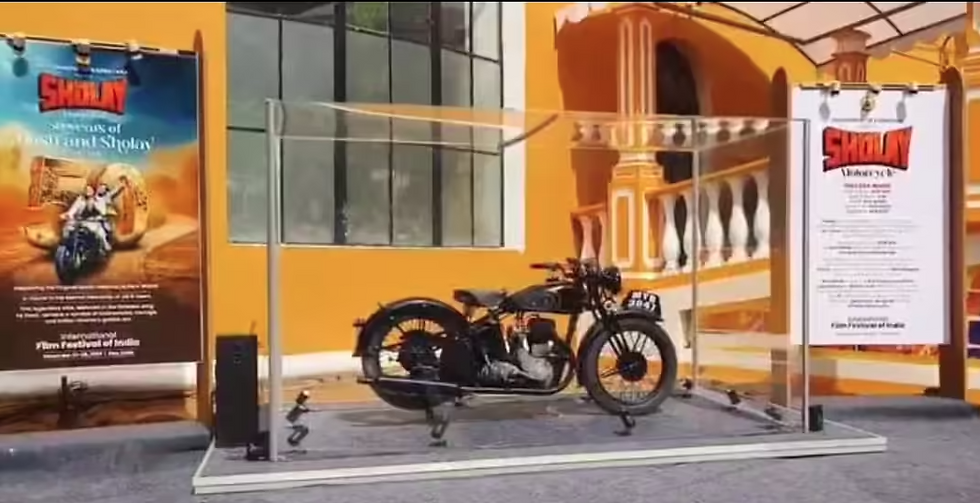
Iconic Bike of "Sholay" at IFFI 2025 premises is actually a War Bike

Iconic Sholay Motorcycle Shines at IFFI 2025: The 1942 BSA WM20 Draws Fans, Nostalgia, and Tribute to one of the most beloved, handsome, and legendary actors of all time, Shri Dharmendra (Dharmendra Singh Deol), who was also honoured with the Padma Bhushan in 2012.

The legendary 1942 BSA WM20 motorcycle, immortalised in the timeless friendship anthem “Yeh Dosti…” from the 1975 Bollywood classic Sholay, is once again capturing hearts — this time at the International Film Festival of India (IFFI) 2025 in Goa. Far from the rugged Ramanagara hills where it once sped across the screen with Jai and Veeru, the vintage war-time bike now stands as a shimmering tribute to a film that defined Indian pop culture.

Showcased by the Karnataka Department of Information and Public Relations (DIPR), the motorcycle has been preserved with extraordinary care for over 83 years. Its appearance at IFFI comes at an especially emotional moment, following the recent passing of Dharmendra, whose unforgettable performance in Sholay shaped generations of cinema lovers.

A Treasure Preserved Through Decades

A/V by Pritish Bagdi

Owned by Mr. L.K. Atheeq of Bengaluru, former Additional Chief Secretary and Chairperson of the Bengaluru Business Corridor, the BSA WM20 is more than a collector’s item. It is a moving piece of cinematic and military history. Featuring a 350cc engine, the motorcycle was originally manufactured as a wartime model. Where the ‘W’ in WM20 stands for ‘War’. Production of this model ended in 1950, making surviving units extraordinarily rare.

Mr. Atheeq acquired the bike three years ago and invested significantly in restoring it with original BSA parts sourced from across the world. “People often mistake it for a Bullet,” he joked, noting its classic design and robust frame. Only one component, the oil filter is yet to be replaced, and is expected to arrive later this year.

Despite its age, the bike remains fully operational. “Just the sidecar couldn’t be reattached; that’s my only regret,” said Mr. Hemant, who has closely overseen the preservation efforts. “Otherwise, the motorcycle is very much in running condition.”

A Bike That Captured Real-Life Friendship Too

Beyond its on-screen legacy, the BSA WM20 also holds a special place in the personal memories of the stars themselves. Late Shri Dharmendra and Mr. Amitabh Bachchan were known to love roaming around on this very motorcycle even after their shoot pack-ups. The duo shared a warm, genuine bond with the bike much like the unforgettable friendship of Jai and Veeru. They created countless off-screen memories riding it together, reinforcing its status as a symbol of true companionship both on and off the set.

This emotional connection makes the bike’s appearance at IFFI 2025 even more meaningful, serving as a reminder of the deep camaraderie that defined one of Indian cinema’s most iconic partnerships.

A Tribute to Sholay’s 50-Year Legacy

For Mr. Hemant Nimbalkar, Additional Director General of Police and Commissioner of DIPR, the display is both nostalgic and symbolic. “We wanted to commemorate 50 years of Sholay with something that would appeal to people’s memories,” he said. “No place other than Bengaluru could do it, as the movie was shot around here.”

Visitors at IFFI have been flocking to the bike, capturing photos and asking the same question: “Does it still run?”Nimbalkar feels proud every time he replies: “Yes, the 83-year-old motorcycle is very much in running condition.”

A Bridge Between Eras

The motorcycle, registered as MYB 3047 in the erstwhile Mysore State, has journeyed through generations. Originally belonging to a Karnataka family, it was passed down from grandfather to grandson before becoming part of Atheeq’s cherished collection. His own bond with the film runs deep. He remembers travelling from Akkirampura in Koratagere taluk and waiting five long hours outside Bengaluru’s Kapali Theatre to watch Sholay as a kid.

Today, the BSA WM20 stands proudly at IFFI 2025, merging the past with the present. Flashing a gleaming symbol of friendship, heritage, and Karnataka’s quiet yet pivotal role in shaping one of the India’s greatest cinematic masterpieces.

With the passing of Shri Dharmendra, the motorcycle’s presence offers a heartfelt tribute to the star whose warmth, charm and screen magic continue to live on just like the unforgettable ride of Jai and Veeru.


HKTDC’s Ruzbeh Mistry Reveals Big Opportunities Ahead of Filmart 2026


Swati Bhat

A/V Courtesy: Pritish Bagdi CLICK ON IMAGE TO VIEW THE INTERVIEW

In an exclusive, wide-ranging conversation with Swati Bhat, Editor-in-Chief of The Communique News, Mr. Ruzbeh Mistry, Executive Head – South Asia at the Hong Kong Trade Development Council (HKTDC), shed light on Hong Kong’s rapidly growing collaboration with India’s dynamic film and content ecosystem.

From bold new opportunities in co-production and content distribution to the rise of animation, AI, and regional cinema, the interview offered a definitive preview of what the industry can expect from Filmart 2026, Asia’s leading film and entertainment marketplace.

Strengthening India–Hong Kong Film Cooperation

Mr. Mistry emphasized HKTDC’s strategic focus on India — one of the world’s fastest-growing entertainment markets — and highlighted why Hong Kong is emerging as a preferred business gateway for Indian producers, studios, and OTT platforms.

This year, HKTDC’s active presence at NFDC’s Film Bazaar is part of a larger push to expand bilateral collaboration.

Well-established Indian industry leaders such as Zee TV and Ultra are already regular participants at Filmart, leveraging Hong Kong’s global networking advantage.


Why HKTDC Filmart Matters for Indian Filmmakers & Media Companies?

Filmart is uniquely positioned to offer India direct access to global markets through:

*Co-production alliances with Asian and European partners

*Distribution deals for films, OTT content, and regional-language titles

*Networking with international sales agents & festival programmers

*Exhibitor opportunities for Indian streaming platforms and studios

*Panels, masterclasses, and pitching forums curated for content creators

For Indian exhibitors, the Hong Kong marketplace has consistently generated business outcomes ranging from licensing deals to high-value international collaborations.


21/11/2025: IFFI Premise: Filmmakers investigate how sustainability influences narratives, set designs, and creative decisions.

Pritish Bagdi

IFFI 2025: Exploring Sustainable Storytelling in Global Cinema

The panel discussion titled “Reel Green: Sustainability and Storytelling Across Four Cinemas” at the 56th International Film Festival of India convened filmmakers and producers from India, Japan, Spain, and Australia, offering a unique convergence of global insights on sustainable cinema. Moderated by Naman Ramachandran, an esteemed journalist and film critic, the session delved into how environmental responsibility can influence both production practices and narrative content, integrating craft, culture, and conscience.

Indian Film Producer and Director Nila Madhab Panda initiated the discussion with a frank assessment of cinema’s environmental impact. He highlighted the significant carbon footprint of film production and noted that smaller films often have the flexibility to adopt greener practices. “Cinema is a mass medium. We have only one planet. Half of our energy resources are already consumed,” he stated, advocating for the industry to embrace sustainable practices wherever feasible.

Contrasting Panda’s viewpoint, Mina Moteki, a film producer from Japan, underscored the difficulties of implementing green practices in low-budget productions. She observed that while large-scale projects allow for innovation, smaller projects often face challenges with energy consumption, set management, and logistics. “We are trying to save energy wherever possible,” she remarked, noting a gradual cultural shift in Japanese filmmaking.

Spanish Film Producer Anna Saura echoed these concerns, emphasizing that sustainability is a creative responsibility. She highlighted that conscious decisions, from distribution to on-set management, can mitigate environmental impact without compromising the quality of storytelling. “Every step we take matters,” she asserted, “and even small, thoughtful actions contribute to a greener future.”

Australian filmmaker Garth Davis added a narrative perspective, reflecting on how stories can enhance environmental awareness. “Films connect people back to nature,” he commented. “The younger generation desires change, and storytelling has the power to shape behavior and values.”

The discussion examined global practices and their potential adaptation in local contexts. Davis described how Australian productions focus on respecting people, culture, and the environment, ensuring filming locations are left as they were or improved. Moteki discussed Japan’s blend of traditional and modern practices, including public transport, local hiring, and resource management. Saura highlighted Spain’s Green Film Certification system, which assesses and certifies the sustainability of film productions, guiding teams in adopting eco-friendly practices in catering, equipment, and logistics.

Throughout the session, the panelists emphasized the pivotal role of the younger generation. From creating eco-conscious sets to advocating for sustainability in narratives, youth were recognized as key agents of change. The panelists underscored the importance of mentorship, education, and habitual practices on set to foster a culture of sustainability that transcends borders and generations.

Practical strategies were discussed, including minimizing waste, reusing costumes, and opting for real locations over constructed sets. The panelists also highlighted the necessity for governmental and institutional support. Panda suggested certification systems to recognize sustainable efforts, while Davis proposed policies linking production incentives to environmental accountability.

In a positive note for the global community, the panelists advocated for increased collaborative sessions with other countries, sharing best practices, and adopting effective strategies to lessen environmental impact. They expressed that international dialogues and knowledge exchange would assist filmmakers worldwide in embracing sustainability without sacrificing creativity or storytelling.

By the conclusion of the panel discussion, it was evident that sustainability transcends being merely a technical guideline; it is a mindset. Across India, Japan, Spain, and Australia, the conversation reinforced that environmental consciousness intersects with storytelling, craft, and cultural responsibility. The panel affirmed that cinema can be both impactful and responsible, inspiring audiences and creators alike, and encouraging the next generation of filmmakers to envision a greener, more conscientious world.

IFFI 2025: Exploring Sustainable Storytelling in Global Cinema


bottom of page