top of page
The Communiqué News

Bollywood’s box office journey in 2025 has been marked by recalibration, cautious optimism, and a renewed faith in content-led cinema.

Bollywood Box Office 2025: A Year of Resets, Records and Regional Rise

A work of an AI

After years of fluctuating audience sentiment, the industry witnessed a year where storytelling, scale, and strategic releases played a decisive role in theatrical success.

The first quarter of 2025 set the tone with mid-budget films outperforming expectations, driven largely by strong word-of-mouth rather than opening-day hype. Family dramas and socially rooted narratives found steady footfalls, signalling a clear shift in audience preference towards relatable, emotionally grounded cinema.

By mid-year, big-ticket Bollywood spectacles reclaimed centre stage. Action entertainers and historical dramas, backed by extensive marketing and nationwide releases, delivered robust box office numbers across metros and tier-2 cities alike. Trade analysts noted improved theatre occupancy, particularly during extended weekends and festive windows.

A defining trend of 2025 was the growing influence of regional storytelling within mainstream Hindi cinema. Films that embraced regional themes, dialects, and rooted narratives resonated widely, reflecting India’s evolving cinematic palate. This cross-pollination not only widened audience reach but also boosted repeat viewership.

Record-breaking year: 

In 2025, the Indian film industry achieved a domestic gross of approximately ₹13,395 crore, marking the highest ever recorded. This total encompasses films from all Indian languages released within the country.

Bollywood’s contribution: 

Of the total, Hindi cinema (Bollywood) contributed around ₹5,504 crore to the domestic box office gross, marking its highest annual performance so far.

Big hits leading the numbers: 

Major Bollywood films such as Dhurandhar (which alone grossed around ₹950 crore domestically) and Chhaava were key drivers of this growth.

Bollywood's contributions to the overseas market:

Saiyaara — approximately ₹171–₹172 crore in overseas earnings.

Chhaava — about ₹88–₹91 crore overseas.

Dhurandhar — performed strongly with estimates between ₹150–₹185 crore overseas (still increasing late in the year).

War 2 — around ₹80–₹83 crore overseas.

Housefull 5 — approximately ₹70 crore overseas.

This total encompasses films from Hindi (Bollywood), Telugu, Tamil, Malayalam, Kannada, Marathi, Gujarati, and other regional dubbed languages.

Gujarati cinema’s gross collections increased dramatically, with industry reports estimating approximately ₹242 crore in total theatrical earnings in 2025 a significant rise from 2024.

Estimates for collective box office totals for Marathi films vary, with some trade coverage suggesting that the combined earnings of all Marathi releases were under ₹100 crore, even though hundreds of films released during the year.


According to industry analysis, the share by industry / language segment in the 2025 Indian box office was roughly:

Industry / Language

Approx.

Gross Share

Approx. Gross Earnings

(₹ crore)

Hindi (Bollywood)

~41%

~₹5,504 cr

Telugu cinema

~18%

~₹2,377 cr

Tamil cinema

~13%

~₹1,805 cr

Malayalam cinema

~9%

~₹1,206 cr (derived from share)

Kannada cinema

~4%

~₹536 cr (derived from share)

International & Other (incl. dubbed/global films)

~10%

~₹1,339 cr

Other regional (Gujarati, Marathi, Punjabi, etc.)

Remainder

~₹628 cr (estimated)

Streaming platforms continued to impact theatrical dynamics, but rather than competing, they complemented cinema releases. Many Bollywood films followed a well-planned theatrical-to-digital window, allowing box office collections to stabilise before OTT premieres. Producers acknowledged that clear release strategies helped restore audience trust in theatres.

Music-driven promotions and nostalgia-backed soundtracks also played a crucial role in drawing crowds. Several films benefited from chart-topping songs that revived the traditional link between music success and box office performance, a trend largely absent in recent years.

According to industry insiders, 2025 will be remembered as a year of correction rather than excess. “Audiences rewarded honesty in storytelling,” a Mumbai-based trade expert shared, adding that inflated budgets without substance faced quick rejection.

As Bollywood steps into 2026, the lessons of 2025 are clear—content remains king, theatrical experiences still matter, and audiences are ready to engage when films respect both craft and culture. The box office, once uncertain, appears firmly back in conversation.



Indian Railways has introduced an AI-powered Intrusion Detection System (IDS) using Distributed Acoustic System (DAS) to protect wildlife, including elephants, lions, and tigers, on railway tracks. This technology alerts loco pilots and control rooms 0.5 km in advance of animal presence, potentially saving lives.


Indian Railways Enhances AI System for Wildlife Protection on Tracks

The AI-driven system provides real-time alerts to loco pilots, station masters, and control rooms, facilitating prompt preventive measures. Initially deployed across 141 RKms on the Northeast Frontier Railway, the system has shown effective performance, leading to the awarding of further contracts for 981 RKms across Indian Railways. This will expand the total coverage to 1,122 RKms. This initiative highlights Indian Railways' dedication to wildlife protection and safe train operations. By utilizing AI and DAS, the railways are actively working to prevent animal casualties, aligning with broader conservation objectives. It also sets a new standard for balancing railway operations with wildlife conservation. With AI monitoring, elephants, lions, and tigers are provided safer passage. This follows an unfortunate incident in the Jamunamukh - Kampur section under the Lumding Division of N.F. Railway, where Train no. 20507 DN Sairang - New Delhi Rajdhani Express collided with elephants, causing the derailment of the locomotive and five train coaches. Seven elephants were reported dead, though no passengers were harmed. Following the crash, senior railway officials, including the General Manager of N.F. Railway and the Divisional Railway Manager of Lumding, along with Accident Relief trains, arrived at the scene to conduct restoration work. It was noted that the incident site is about 126 km from Guwahati and is not an official elephant corridor. The loco pilot, upon spotting the elephant herd, applied emergency brakes, but the elephants collided with the train. Meanwhile, Assam Chief Minister Himanta Biswa Sarma expressed deep sorrow and ordered an investigation into the deaths of seven elephants—three adults and four calves—in a tragic train collision.

The Chief Minister stated, "We are deeply saddened by the death of seven elephants—three adults and four calves—in a tragic train collision earlier today. I have directed the Forest Department to conduct a detailed enquiry on this deeply disturbing accident and take steps to further secure our wildlife corridors, particularly during low visibility seasons." Additionally, Rajya Sabha MP Sukhedu Sekhar Roy, in a letter to Railway Minister Ashwini Vaishnaw, highlighted the incident, noting that such occurrences continue due to trains exceeding speed limits in designated elephant corridors. He described these deaths not as accidents but as the result of human negligence, emphasizing that speeding trains pose an ongoing threat to elephants and other wildlife.


The event was graced by Bollywood celebrities, including Deepika Padukone, Ranveer Singh, Sonam Kapoor, Riteish Deshmukh, and several others...

Nita Ambani shines in Kundan Polki earrings that are over a hundred years old


Swati Bhat

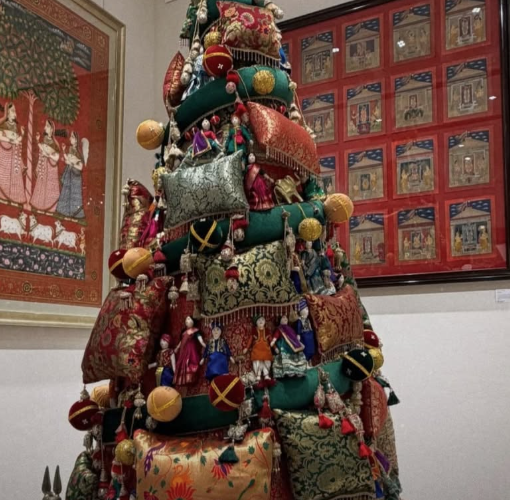
Mumbai (Maharashtra) [India], December 5: Nita Ambani, Founder-Chairperson of Reliance Foundation, paid tribute to artists and artisans during the Swadesh flagship store celebration at Eros, dedicating the event to India's remarkable legacy of artists and National Award-winning artisans. The celebration was graced by numerous celebrities, adding glamour to the occasion. In her address to the media, Nita Ambani praised the National Award-winning artisans, calling them the "pride of India and the stars of tonight." She stated, "We welcome you to Swadesh. Today, we celebrate the start of the festive season by honoring our artists and artisans. They are the pride of India and the stars of tonight. We have with us several National award-winning artists and artisans. With joy and respect, I extend a warm welcome to them. They come from all over India—from Kashmir, Odisha, Tamil Nadu, Hyderabad, and Jaipur. Let's give them a big round of applause. They are the true pride of our time. Have a wonderful festive season." The artisans honored by Nita Ambani include Biren Basak, Padma Shri Awardee (2021), known for Tangail and Jamdani weaves; V. Panneerselvam, Tanjore painter awarded the Shilp Guru Award (2019) and National Award (2011); Shammi Bannu Sharma, a seventh-generation miniature painter and National President Awardee (2014); GhanShyam Sarode, a celebrated Paithani textile designer and handloom revivalist; and Gunjan Jain, an Odisha Ikat textile artist and National Award winner (2024).

Nita Ambani, Founder and Chairperson, Reliance Foundation, with master artisans at the launch of "Swadesh" store.

Top row left to right : Vijayakumar, Krishnamoorthy Balaraman, Chetan Devidas Shet, Suresh Kumbhare, Nandu Tribhuvan, Kamlesh Jangid. Bottom row left to right: Gajam Yadagiri, Gowrabthini Ramanaiah


bottom of page